
I rebuilt the emotional layer of a live coaching platform — before its AI ever met a user.
AI features about to launch into a product whose users had never seen them. I designed the conversational trust layer, rebuilt onboarding and subscription flows, and cut dev handoff time by 35% — without pausing a live product once.
OCT 2024 – JUN 2025 · FOUNDING PRODUCT DESIGNER · TEAM OF 5


01 · THE PRODUCT
A coaching platform with a trust problem dressed as a navigation problem
WHAT IS MYGROWTHUB
A platform connecting professionals with mentors across health, business, and legal fields.
Four subscription tiers — Start, Engage, Grow, Boost.
Real users, real revenue, AI coaching features about to launch.

THE BRIEF
Founding Product Designer. Build the design system from zero. Redesign onboarding and subscription flows. Design the conversational UI layer for AI coaching features before they go live to users.

WHY IT MATTERED
AI features that users do not trust do not get used. Features that do not get used do not justify the next round. The design problem was not the AI — it was the belief gap between what the AI could do and what users were willing to let it do.
02 · DISCOVERY
The drop-offs were not about navigation. They were about belief.
WHAT I ASSUMED GOING IN
Users were dropping off because the product was hard to navigate. The solution was cleaner UI and better IA.
THE PIVOT
I reframed from navigation redesign to trust architecture. The primary question became: how do you design a conversational AI that earns permission before it makes a suggestion? This reframe changed the copy, interaction patterns, onboarding sequence, and subscription flow logic entirely.

WHAT THE RESEARCH SHOWED
Users were leaving at the exact moment the product asked them to trust a system they had never been introduced to. The AI's suggestions were arriving before users had any reason to believe in them. After synthesis across user interviews, stakeholder alignment sessions, and drop-off data analysis, the root cause was clear: it was a trust architecture failure.

"The design problem was not the AI. It was the gap between what the AI could do and what users were willing to let it do."
03 · CONSTRAINTS
Three constraints. No room to pause.

LIVE PRODUCT
Thousands of active users. No feature freeze. Every design decision had to ship without disrupting current usage patterns across all four subscription tiers.
AI NOT YET VISIBLE
Designing trust for a system nobody had touched yet. No behavioural data to learn from. Every decision was hypothesis-led and prototype-tested — I generated 20+ conversational UI prompt variations and selected based on user mental model testing.
WIX PLATFORM LIMITS
No prior design system. Wix's platform constraints forced creative problem solving at every step — some Figma designs could not be replicated, requiring redesign of intended flows within platform boundaries.
04 · SOLUTION
Four decisions. Each one earned.

DECISION 01 — CONVERSATIONAL TRUST LAYER
Authored every AI coaching UI prompt from scratch — establishing clear, consistent tone that built user confidence in automated suggestions. AI explains its reasoning before making a suggestion. Warm, never prescriptive. Set foundational content standards for all future AI interactions.
DECISION 02 — SUBSCRIPTION FLOWS
Redesigned subscription and plan-management workflows to minimise cognitive load and simplify navigation. Rebuilt mentor profile interfaces and progress-tracking dashboards for transparency and accountability. Bookings +25%. Drop-offs −28%.


DECISION 03 — GRADUATED ONBOARDING
Rebuilt onboarding to introduce AI capability in stages — earning micro-trust before asking for full engagement. By the time users reached their first AI suggestion, they were already primed to receive it.

DECISION 04 — DESIGN SYSTEM
Built a unified design system from zero — streamlining dashboards, onboarding, and payments. Component library, design tokens, style guides. Dev handoff time cut by 35%.
WHAT I LEFT OUT — AND WHY


Full AI mentor matching automation was scoped and deferred. The trust layer had to come first. Shipping automated matching before users trusted the AI's voice would have accelerated drop-off. The scalable AI integration framework I built — mapping predictive coaching suggestions — became the foundation for that feature post-MVP.
05 · TESTING
Testing is the moment of truth. Make or remake.
HOW WE TESTED
Interviewed potential customers under NDA. Tested 2-3 user flows per participant, one product at a time — this cut the testing timeline by half. Focused on evaluating user flows, designs, and overall product experience.

HOW WE MEASURED
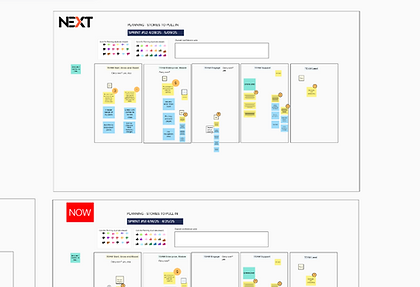
Color-coded success system — red for critical issues needing immediate attention, yellow for focus areas, green for passing. Three or more users flagging the same issue flagged it as critical. Priorities were data-driven, not opinion-driven.

06 · AI IN THIS PROJECT
I designed for AI. I also designed with it.
DESIGNING FOR AI
Authored every conversational UI prompt for AI coaching features. Built the AI integration framework — mapping predictive suggestion flows and automated mentor matching logic. Established tone, timing, and trust architecture for how the AI earns the right to speak to users.
DESIGNING WITH AI
Generated 20+ conversational UI copy variations using AI tools, then selected based on user mental model testing. Used AI to accelerate edge case discovery in trust interaction flows. AI was a collaborator in designing a product that would itself use AI.
07 · IMPACT
The numbers are real. Here is what they mean.
NPS POINTS
Users began trusting AI suggestions during prototype testing. The belief gap closed.
+40
DROP-OFFS
Subscription flows stopped losing people at the decision moment.
−28%
BOOKINGS
Mentor profiles made the value visible before the click
+25%
DEV HANDOFF
Unified design system — first single source of truth the team ever had
−35%
08 · REFLECTION
The best call I made. The one I would change.
BEST DECISION
Re-framing from navigation to trust before touching any screens. The instinct to audit the assumption before solving it saved weeks of work in the wrong direction — and produced a fundamentally better product.

WHAT I WOULD CHANGE
Involve engineering earlier in the AI integration framework decisions. Some conversational flow logic needed revision late because technical constraints surfaced at handoff rather than discovery. Earlier cross-functional alignment would have prevented that loop.
"The hardest part of this project was not the design.
It was convincing a product — and its users — that trust could be designed."
CARMELINA PIEDRA · FOUNDER, MYGROWTHUB
"
She is driven and passionate. Her 'yes, and!' attitude is something I love, and her energy is infectious. She is a great Product Designer.